
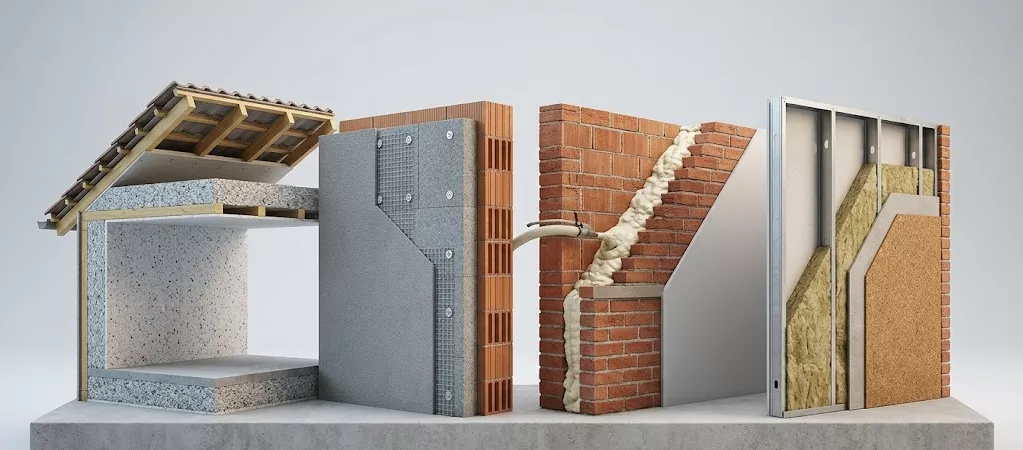
To thermally insulate the envelope of a building (excluding openings such as windows and doors), the key is to act on the enclosing walls (exterior walls), the roof and the floor/slab.
Regarding the exterior walls, there are mainly three construction solutions, and the choice of material depends directly on which of these options is used:
1. Methods for insulating exterior walls
A. Exterior Insulation (SATE / ETICS)
It is the most efficient solution in rehabilitation and new construction, since it wraps the building on the outside and eliminates almost all thermal bridges (pillars, slabs).
- How it is done: The insulating material is fixed to the existing facade and covered with a protective mortar finished with paint or plaster.
B. Air Chamber Injection Insulation
Widely used in existing buildings with double-leaf walls (very common in constructions from the second half of the 20th century).
- How it is done: Small holes are made in the wall (from the outside or from the inside) and the insulating material is injected fluidly until the interior void is filled.
C. Interior Insulation (Transfixed)
It is used when the exterior facade cannot be modified (e.g. protected buildings or neighborhood communities where there is no agreement).
- How it is done: The insulation is installed on the interior face of the home and closed with plasterboard panels (Placo/Pladur style). It slightly reduces the usable area of the home.
2. Most commonly used materials in exterior walls
The materials are mainly divided into three large families:
1. Synthetic Insulators (Petroleum-derived plastics)
They offer maximum insulation capacity with minimum thickness (very low thermal conductivity, approximately 0'022 - 0'038 W/m·K, and have great resistance to water.
- EPS (Expanded Polystyrene): The classic "white cork". More economical and lighter, widely used in SATE systems. The versions with graphite (gray) improve the insulating capacity by 20%.
- XPS (Extruded Polystyrene): Much denser, waterproof and with very high compression resistance. Ideal for low areas of facades, plinths or roofs.
- Polyurethane (PU / PIR): It is used both in rigid panels and in projected or injected foam. It has one of the best thermal performances on the market per cm of thickness.
2. Mineral Wool / Wool Techniques
They provide great thermal insulation, excellent acoustic protection and are non-combustible (high safety in the event of a fire). In addition, they are breathable (prevent condensation).
- Rock Wool: Derived from volcanic rock. Ideal for SATE, interior overhangs and blown into air chambers. It has very good dimensional stability.
- Glass Wool: Derived from sand and recycled glass. Very light and flexible, common in overhangs of plasterboard and filling chambers.
3. Natural and Ecological Insulators
Sustainable materials, with a low carbon footprint, high breathability and great thermal inertia (heat retardation in summer, very useful in our climate).
- Cellulose: Recycled paper treated with boron salts (to make it fireproof and insecticide). It is mainly used injected or blown into air chambers.
- Natural Cork (Agglomerated / Expanded Cork): Resistant to humidity, rot-proof and 100% natural. Widely used in ecological SATE and exposed facades.
- Wood Fiber: High-density blown wood panels or wood that stand out for their ability to protect against summer heat.
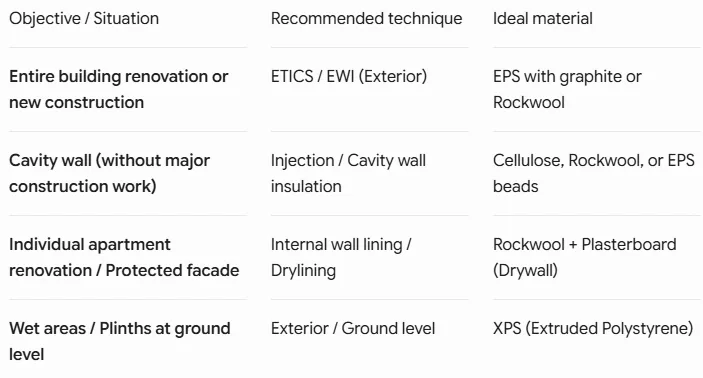
Summary to choose the best option:
The collaborating companies of vull.cat will help you insulate your home so that you can significantly reduce consumption. Let's talk?
 VULL.CAT AI